

What you’ll find in this blog:
- Massive ROI: A case study showing an 80% reduction in admin time and a 40% cut in build costs by automating a critical 5-hour per week task.
- Agentforce Breakthrough: The technical revelation of how AI Agents were used to instantly enable batch processing (generating all partner statements at once) in Salesforce Flow, eliminating the need for complex custom APEX code.
- Strategic Shift: A proposal for a new Salesforce automation hierarchy (Agentforce → Flow → Code) that prioritises secure, context-aware AI.
- Low Running Cost: Confirmation that this high-value automation costs the customer just £1.36 per week in Agentforce credits.
We are delighted to be able to say that Gourmet Hog Roast is now Live with Agentforce.
This project gave us a front-row seat to what Salesforce’s AI capabilities can really do, and the results surprised even us.
When we talk about a successful implementation, there are a few outcomes we always aim for:
- Time Saved
- Cost Saved
- Improve the experience of being a Salesforce customer
- Deliver scalable solutions that consider the next optimisation, not just the here and now.
With this rollout, Agentforce delivered across every measure. Reducing task time by 80% and cutting delivery costs by 40% made it clear we’d chosen the right platform, and it’s genuinely enjoyable to work with.
While we can’t put a percentage on UX (User experience) or Technical Debt Reduction, we can at least say that using the Agentforce UI (User Interface) is quick, flexible and low code which equals easy to scale with less!
Nick from GHR had this to say:
“Using the Agent force feature has been a game changer as it’s taken away an incredibly important, but otherwise monotonous task. It’s enabled us to focus more on working on the business, rather than in it.”
The Brief
Like any Salesforce project, big or small, it starts with understanding the customer’s pain points.
We stay in close contact with the leadership team at Gourmet Hog Roast, and through those conversations we uncovered a repetitive task eating up as much as five hours every week.
The job itself sounded simple. We needed to generate partner statements so their partners could be paid accurately and on time.
The data was already in Salesforce and once the statements were manually created and sent, payments still had to be made separately through the bank, after approval. Lots of steps and lots of manual work during the statement preparation stage using excel.
Our goal was clear! We needed to deliver something automated, scalable, and accurate while giving the Gourmet Hog Roast team those hours back to focus on revenue-driving work instead of admin.
The game was afoot!
The Solution
The answer quickly became clear: we needed a structure in Salesforce to handle partner statements properly.
That meant creating two custom objects:
- One to capture the partner statement itself (the “header”)
- Another to capture the statement lines (the “items”)
Why two objects? Think of it like an invoice or bill, you’ve got a header record with the key details (like date, total, and recipient), and beneath it, a list of individual line items. A partner statement follows the same pattern of one statement, many items.
From there, we added automation. Each week, the system now generates statements for one or many partners in a single run. It pulls in any relevant payments, allocates them to the right statement lines, and keeps everything in sync.
We also needed an interface that allowed the team at gourmet to launch the action. They could specify the date range of payments to be picked up and/or the accounts to process (All or One).
Historically, this kind of requirement would have called for custom code. Salesforce Flows are powerful, but they can be restrictive when it comes to batch processing (for example, generating all partner statements in one go rather than one by one).
We decided to try Agentforce out as the gourmet team had been hearing about it and had some interest in how it could enhance what they do.
We were surprised to say the least!
Why we used Agentforce
When we kicked off the project, we assumed we would need APEX in the final build. So we started by creating a simple Flow to handle a single partner statement, just to validate the logic before committing to the code build.
We handed that Flow to the AI Agent to see if it could trigger the automation based on natural language instruction.
Not only did it run the Flow, it also generated an input screen so we could enter the date range. Then, after we prompted it with “Generate statements for all accounts,” every partner statement appeared in the Statements object, automatically.
Did we just build the core functionality in half the expected time? The answer was Yes!
We knew with some tweaking, guardrails and stress testing we could have a solution here.
We stress tested the agent passing 5x the number of accounts it would ever need to process and it passed with ease. A surprise for sure! Up to this point, our expectation was much more reserved.
We mentioned a 40% reduction in build cost earlier. The remaining 60% still matters, requirements still need to be scoped, testing still needs to happen, and deployment doesn’t do itself. But when you can deliver solutions faster, reduce technical debt, and improve UX all at once, it changes the equation and in this case the approach.
Traditionally, Salesforce admins have followed a kind of “automation hierarchy”:
Workflow Rule → Process Builder → Flow → Code
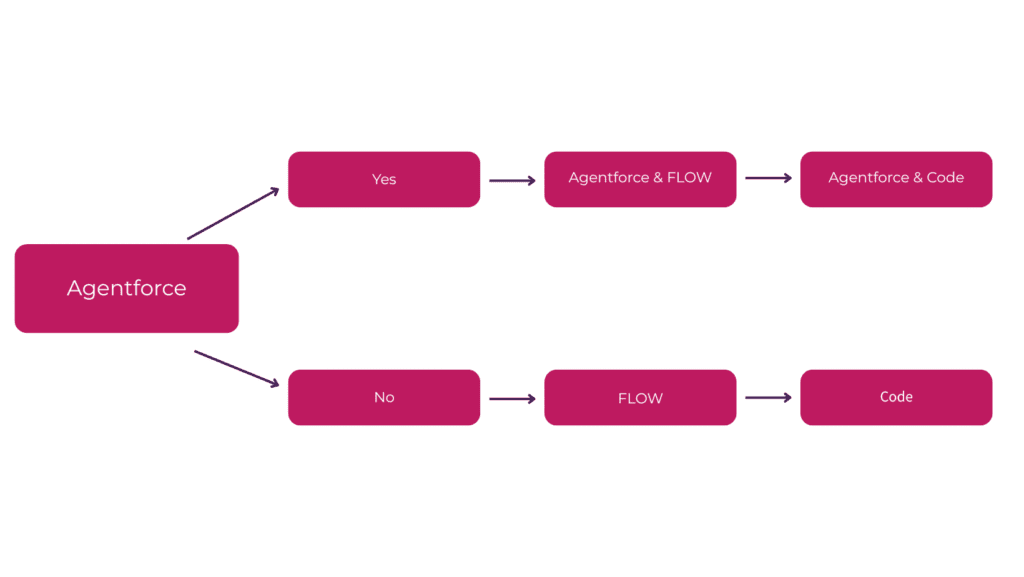
(Yes, I’m old enough to remember all of them!)
But after this? The order is starting to look very different…
Great, so what does it cost?
A lot less than you’d think.
We go some way to explaining the various pricing options for Agentforce here, take a look.
However, from a Gorumet Hog Roast perspective, because this particular use case is so lean, Running this automation will cost just £1.36 per week in Agentforce credits.
The return on that investment is massive, around 99%.
Hard to argue with that.
The more we work with Agentforce, the clearer it becomes that this isn’t just another add-on. It has the potential to become part of your daily workflow.
Let’s be honest, you’ve probably used ChatGPT at some point. And yes, it’s useful… to a degree. But external LLM, especially the free ones, come with limitations. They don’t know your business, your data, your processes, or your governance standards unless you manually feed them that context. That means more effort, more risk, and more disconnected outcomes.
Agentforce changes that. It gives you a secure, Salesforce-native way to use AI with built-in context, so it understands the data and processes you already work with. That’s a game changer.
There’s another advantage too. Instead of scattering automations across the platform (which has served us well), Agentforce opens the door to centralised automation delivered to the right people in one place and that saves time, improves user experience, speeds up ramp up’s and future-proofs your org.
That’s not just convenient. That’s strategic.