
The power of small changes
As the year draws to a close, many teams start thinking about big transformation projects for the next financial year – new tools, new integrations, major upgrades.
But what if the biggest improvements don’t come from sweeping change? What if a handful of targeted tweaks inside Salesforce could help your team finish stronger, faster, and more efficiently?
At Xenogenix, we see it all the time: small adjustments that deliver measurable results. With Salesforce, incremental optimisation is often the key to unlocking new levels of productivity – without the disruption or cost of a large-scale project.
Here are five high-impact, low-effort Salesforce wins you can put in place before year-end.
1️⃣ Automate lead routing and follow-ups
Manual lead management slows sales momentum and creates inconsistent experiences. Automating lead routing ensures new opportunities go directly to the right reps based on territory, product, or lead score – no delays, no missed chances.
For example, Salesforce Flow or Einstein Activity Capture can automatically assign leads, trigger follow-up tasks, and send personalised thank-you emails.
👉 Quick win: Set up or review lead assignment rules to ensure new leads are distributed within minutes, not hours.
The result: Faster response times and more evenly balanced pipelines.
2️⃣ Clean up duplicate and outdated records
Duplicate data doesn’t just look messy — it damages your reporting accuracy and your customer experience. A cluttered database can slow Salesforce down, confuse teams, and waste time.
Use Salesforce’s built-in Duplicate Management, or apps like DemandTools or Cloudingo, to identify and merge redundant records. While you’re at it, remove outdated contacts or inactive accounts that no longer add value.
👉 Quick win: Run a monthly duplicate check and automate merge approvals where possible.
The result: Cleaner data, clearer reporting, and fewer headaches for your team.
3️⃣ Simplify opportunity stages and naming conventions
Over time, opportunity stages often multiply and naming conventions become inconsistent – especially in growing sales teams. Too many stages or unclear definitions can make forecasting and pipeline reviews unnecessarily complicated.
Start by reviewing your opportunity stage definitions and mapping them to your actual sales process. Then simplify where possible – keep stages meaningful and intuitive.
👉 Quick win: Audit your opportunity stages; remove or consolidate rarely used ones and align naming conventions across teams.
The result: Easier reporting, faster onboarding, and improved forecast accuracy.
4️⃣ Review inactive accounts and opportunities
An inflated pipeline full of dormant deals can distort forecasts and consume valuable follow-up time. By identifying inactive or stagnant opportunities, your team can focus on what’s real – and re-engage cold accounts strategically.
Salesforce reports can highlight opportunities with no activity for 30/60/90 days, or you can automate this using simple triggers and notifications.
👉 Quick win: Create a dashboard showing all opportunities with no activity in the last 60 days and task owners to review or close them.
The result: A more accurate forecast and better prioritisation for your sales team.
5️⃣ Create dashboards for proactive forecasting
Real-time visibility changes how teams make decisions. By building simple, actionable dashboards, you empower managers and reps alike to spot risks early and act fast.
Whether it’s tracking open opportunities, activity levels, or pipeline coverage, Salesforce dashboards can give teams the clarity they need to stay focused.
👉 Quick win: Build a “Next 30 Days” dashboard showing open opportunities, pipeline coverage, and deal velocity.
The result: Better decision-making and accountability across sales, service, and leadership.
Bonus: Celebrate and communicate the wins
Small improvements deserve recognition. Sharing quick-win results helps build momentum and reinforce a culture of continuous improvement.
If automating lead assignment saves your team 10 hours a week, or cleaning up data improves forecast accuracy, celebrate it – and make sure everyone knows what worked.
These incremental wins create long-term impact by strengthening adoption, confidence, and collaboration across your Salesforce environment.
Putting it all together
You don’t need a huge budget or a six-month project plan to improve Salesforce performance. The most successful organisations focus on consistency and clarity – refining the basics, automating what matters, and making decisions with reliable data.
By tackling just a few of these quick wins before the end of the year, you’ll set the stage for a more productive, insightful, and successful 2025.
🔗 Next step: Download your Executive Guide
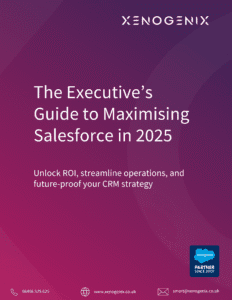
For more insights on maximising Salesforce in 2025 – including AI, integration, and governance strategies – download our free resource below.

Samantha Mathie is a Senior Digital Marketing Executive at Xenogenix and has been part of the business for four years. Before joining Xenogenix, she spent more than eight years working independently as a marketing consultant.
With a background in IT, telecommunications and video conferencing, Samantha specialises in B2B technology marketing, digital campaigns, content and connected customer journeys. She is particularly skilled at turning complex subjects into clear, engaging communications.
As an author for Xenogenix, Samantha shares practical guidance on digital marketing, campaign planning, content and communicating technology effectively.